COURSES AND WORKSHOPS
COURSES AND WORKSHOPS

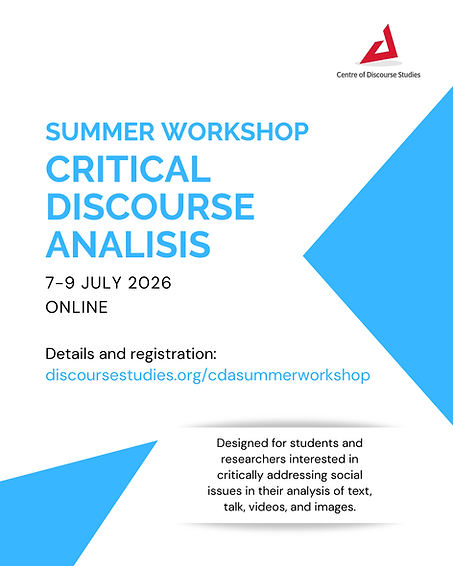
SUMMER WORKSHOP: CRITICAL DISCOURSE ANALYSIS
Workshop facilitator:
General information:
Dates: 7-9 July 2026
Time: 2pm - 4pm (CEST/UTC+2 time zone)
Place: online (Zoom meetings)
Language: English
Price: €100
Course certificate included in price
Registration open until July 5th
Course description:
How can we analyze text, talk, videos, and images to critically address social issues? Join us for our online summer workshop in Critical Discourse Analysis (CDA), July 7th-9th, 2026. This practical workshop will focus on tools and strategies for analyzing language and visual communication in ways that allow us to examine their social, political, and ideological implications. The CDA Summer Workshop is open to students and researchers with CDA experience (including participants of our Winter, Spring, and Fall CDA Courses) who are looking to refine the problem-oriented focus of their analytical frameworks as well as anyone interested in incorporating discourse-analytical approaches into their work.
This workshop is organized and facilitated by Dr. Lucía de la Presa, coordinator, researcher, and professor at the Centre of Discourse Studies.
Program:
Day 1. July 7th, 14:00 to 16:00 (CEST/UTC+2 time zone):
Approaching CDA as three-dimensional: A practical guide for the analysis of context, text, and social, political, and ideological Implications
The first session provides an overview of the workshop’s focus on the three dimensions or steps necessary for robust, problem-oriented critical discourse analysis. In this session, we will center on context, as the first, foundational step of the critical research process, with discussion and group exercises aimed at equipping participants with a roadmap for applying a multidimensional study of context within their own research.
Day 2. July 8th, 14:00 to 16:00 (CEST/UTC+2 time zone):
Problem-oriented textual analysis
This session focuses on tools and strategies for analyzing forms of multimodal texts (combinations of text, image, and other semiotic modalities) in ways that are insightful and productive for problem-oriented research questions. Participants will have the opportunity to apply these tools and strategies of textual analysis with in-class group exercises.
Day 3. July 9th, 14:00 to 16:00 (CEST/UTC+2 time zone):
Uniting the study of context and textual analysis to consider the social, political, and ideological implications of discourse
The final session will build on the previous ones to consider the ‘so what?’ of discourse analysis. In this session, we will engage in discussion and group work examining the ideological and social-political implications of our discourse-analytical findings and why an inter- or trans-disciplinary approach to CDA is crucial to the ability of our research to provide these insights.
If you wish to register for an individual class session, please contact us directly at: